The Lorelei Signal

The Enemy of the Good
Written by R.M. Linning / Artwork by Marge Simon
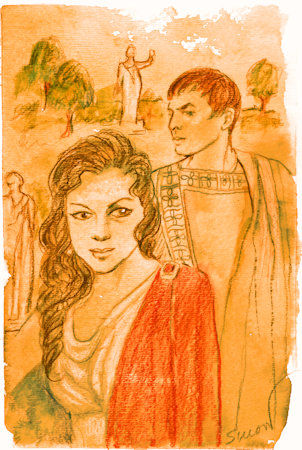
The consort of the Great Artist was inured to attention, she received torrents of it every moment she ventured out from their citadel. There were the well-wishers inquiring as to the Artist’s health. There were the curious who wondered what the Artist was currently working on. There were the acquisitive who wanted a piece of the Artist’s work. And there were the criminals who wanted to part the Artist from his immense wealth. She smiled and left them all with kind but vacuous replies.
She was an accomplished and beautiful woman in her own right and it did not trouble her that precious little of that attention was directed her way. She loved her husband and marveled, too, at his brilliance but her forays filled her only with sadness. She would trade it all away for even a nod from the one person who really mattered.
When she returned home she found the Artist where she had left him, in his studio at the top of their spire. He favored her with a thin smile before his attention snapped back to the three pieces he had been laboring on now for over a decade—a portrait of her, a chamber sonata, and a cycle of sestinas. The room was strewn with musical instruments, paints, brushes and dog-eared reference tomes. Beyond expansive windows the city and its surrounding fields stretched to the shimmering horizon.
“How was the market, my dear?” he asked dispassionately.
“It is a beautiful day. Have you noticed?” she asked in turn.
“Is it?” he murmured. She fought back an angry reply.
All three works were crafted in her honor and image. Her husband no longer worked on anything else. At first she had been overwhelmed by his devotion but with time that devotion had become obsession. Her portrait became an idealized image of her, of her as perfection. The beauty mark above her left eye was gone along with the slight twist of her lip.
She turned and left.
~ * ~
The Artist spent the day as he spent every day, before his creations, adding a daub of paint here, contemplating a tonal modulation there, reworking an enjambment. He knew these were his greatest works. His name was already synonymous with those of Titian, Mozart and Yeats, the greatest masters of Old Lost Earth whose names had become bywords, their own works long since destroyed or forgotten. He hoped each addition or alteration he made would be the last but, inevitably, the feeling of fulfillment he felt upon completion of a piece remained tantalizingly beyond his grasp.
He rarely left their home save for necessary state functions. He and his wife had no children, a sacrifice to which she had sadly acceded. They had once been rapturously happy together but now he only saw his wife in the three masterpieces he strived to perfect.
That evening when he descended for dinner his wife tried to engage him in conversation but his mind inevitably wandered back to his work. He picked perfunctorily at his food and lingered with her for a few minutes before leaving.
When the door of the lift opened he was momentarily dazzled by the array of lights from the city below before a darting movement caught his eye. At the same moment he felt a draft sweep over him. The dark shape of a man stood framed by one of the panoramic windows, now shattered. He was throwing a large bundle out of the window.
“Stop!” the Artist called out and ran towards him. The other man glanced back giving him the slightest glimpse of his thin aquiline features but then with a grin threw himself wildly out of the window. By the time the Artist reached the opening he could see nothing in the darkness below.
The Artist paused only a moment before racing back to set off the alarm. Only then did he turn on the lights. The portrait and books of poetry and musical notation were gone.
~ * ~
The robbery was a sensation and scandal in one. Public inquiries and manhunts yielded nothing. The Artist held on to a desperate hope his three unfinished masterpieces would be recovered until months later a tip led to an offworld raid. No one was apprehended but irrevocably charred remnants of the stolen works were found in an incinerator at the site.
The Artist was devastated by the news. He descended into a deep depression from which he emerged only with the help of his wife. He made several abortive attempts to recreate the three works from memory, each time abandoning his efforts in frustration. In the meantime the Artist’s prodigious talents could not be held in check. New works began to appear after fallow decades and he was no longer tempted to return to the pursuit of perfection that had once captivated him. A sense of joy also returned to his relationship with his wife and soon they were seen arm in arm in the streets of the city.
~ * ~
The Artist loved to watch his wife while she walked amongst the people of the capital. He particularly enjoyed watching her on market days wending her way through the stalls asking after the vendors’ families and cooing over their produce. On one such day his wife had left early and he hurried to catch up with her. He spotted her at the edge of the market grounds beneath the surrounding colonnade. He paused to watch her. She was deep in discussion with a man and at one point handed a bulging coin purse over to him. The man bowed his head over her outstretched hand and before he left glanced briefly out over the market in the Artist’s direction. He looked remarkably like the man the Artist had glimpsed the night of the robbery.



R.M. Linning lives with his family in the Okanagan region of British Columbia, Canada and has recently retired from his work as a researcher in molecular biology and bioinformatics. He writes fiction of all kinds and lengths.
His previous work can be found in the Ink Stains 14, Crimeucopia Crank It Up! and Black Hare Press Patreon Year Five anthologies as well as online at Stupefying Stories (http://stupefyingstories.com/) and Black Cat Weekly (https://blackcatweekly.com/).
His other interests include painting, languages, and computer programming.