The Lorelei Signal

If You Kept Looking
Written by Jillian Schedneck / Artwork by Marcia Borell
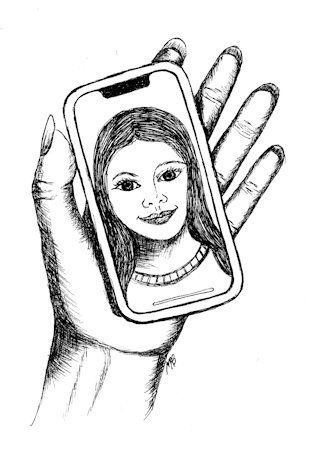
The Exhibition would close in two days. Everyone in Miranda’s Ethical Research Team had already visited, spent their singular five minutes gazing into the essence of their subconscious. The last four team meetings had been filled with recounts of what they’d seen, a language of gushing camaraderie Miranda couldn’t join. This morning, the team supervisor had (jokingly) ordered Miranda to visit The Exhibition and return with a full report. With trembling hands, Miranda slid on her coat, fussing with the zipper, and paced the main thoroughfare of the small campus before bracing herself and trekking to the museum on the outskirts.
The security bot seized Miranda’s staff ID and scanned it with suspicion, its scanner eye glinting like it was appraising stolen goods rather than verifying staff. Miranda was sure she’d seen this bot waving other staff straight into the queue without a glance at their ID. When it finally handed her a number, Miranda exhaled and joined the line.
She spotted Heath, the administrative head of her division, two people ahead in the queue. He was easy to notice with his legs wide apart, his shoulders pinned back, chest out, chin high. He had a gleam in his eye as he met Miranda’s gaze, smiling as beneficently as a town Mayor. Miranda waved.
“Hello there,” he boomed, and then, wrinkling his brow, “Have we met?”
Miranda’s cheeks flushed. “I'm Miranda, Ethical Research Team? I'm on the Human-Bot Cooperation Committee with you.”
“Of course! So sorry.” He scratched his grey beard. “First time at The Exhibition?”
“How did you know?” Miranda gave a cordial laugh and hugged herself tightly for warmth, even though it was one of those bright winter afternoons this city was known for.
“I was nervous too, my first time.” Heath swapped with the people behind him to stand beside Miranda. “What kind of picture encapsulates the contents of my very soul?” he said in a thunderous voice. “And what I saw—it was beautiful! I’d like to burn that image into my retinas if I could.”
“Is it okay to ask what you saw?”
“Of course, I’m not one of those people who keeps it a secret. I was shown a pair of blue sneakers! Were they from my childhood? Or a dream? Looking at those sneakers brought up memories, like summers by the lake with my partner, and my mother, who died last year.” His voice quivered. “It was just amazing.” He brought a trembling hand to his heart and wiped at his glistening eyes.
Miranda cleared her throat. “Wow. What an experience. We’re so lucky Mitzi Lear decided to introduce her Exhibition here.” Miranda parroted what her team members said. “Did you see Vice Chancellor Genevieve at Mitzi’s talk?”
“Imagine letting that machine scan your brain in front of the whole audience!” Heath bellowed.
“Yes, and then Genevieve’s image was just a cow. Weird, I thought at the time, but then she burst into tears, wrapping her arms around Mitzi!”
“Who would have thought that cow would remind Genevieve of a childhood trip to Sweden.” Heath shook his head. “You never know what’s lurking in people’s brains, or how Mitzi worked out how to reveal our most important memories.” Heath blinked slowly and swayed from side to side. “Now, can I ask why you’ve waited so long? Have you been out sick?”
Miranda rubbed the back of her neck. “Just busy.” It was too much to explain her many reasons for waiting. The anticipation was enticing, yes. Plus, in her unguarded moments, Miranda let herself admit she believed The Exhibition needed more practice to reveal the essence of her more complicated and unusual brain. And what if The Exhibition was saving its best for last? Her phone vibrated a warning in her jacket pocket, reminding her to take long, deep breaths to slow her rapid heartbeat.
A young woman in a bulky overcoat strode toward them, clutching a clipboard. Miranda had seen her at the last university research morning tea.
“Sorry to interrupt,” the woman began. “I’m Kanchana from the Urban Research Team. Mitzi’s commissioned us to find out how viewers are interacting with The Exhibition. Would you be willing to have a quick chat after your viewing?”
“I’d be glad to.” Heath gestured toward Miranda. “And I’m sure Miranda would help. She’s in the research team next to yours.”
“New?” Kanchana sent a pinched smile Miranda’s way.
“We met last week, at the morning tea.” Miranda didn’t know why she bothered.
Kanchana ran her hand through her long wavy hair. “Sorry.” She handed over her screen and didn’t move until Miranda clicked her details onto the consent form with a stroke of her digital pen. Kanchana grasped her screen and approached the people behind Miranda, laughing and calling them by name.
As Miranda and Heath neared the front, Heath leaned in and gazed meaningfully at Miranda. “Good luck.” Then his form retreated behind the curtain. Miranda fought to control her ragged breathing. In five minutes it would be her turn.
She thought of her glassy-eyed colleagues, the astonishment they expressed over their neon abstracts, their intricate watercolour renditions of a bustling city street, their Picasso-like figures that resembled a succession of past lovers. All that, it was fine. Shallow, but fine. Mitzi’s brain scan would cut to the essence of her like a blade and uncover something no one else could, or ever even tried. She just knew it.
“Number five twenty-two, please step inside.” An automated voice summoned. For a moment the world swirled around her. She clasped her hands together and stepped through the black curtain, entering a long dark hallway which twisted and turned. When the hallway spilled her out into the vast viewing room, sound vanished. Suddenly, it was as if no noise could make its way into this dark, cavernous space eclipsed of all light except for a white neon strip on the floor and a large, illuminated blank canvas ten feet away. A voice called, “Please step on the white line and close your eyes. Your scan will begin.”
Miranda did as she was told and perceived a bright pink ray of light pass over her face.
“Please open your eyes to view your unique creation, brought to you by Mitzi Lear.”
Miranda clenched her eyelids tight and whispered “open”, then flung them wide. She blinked, adjusting to the canvas’s glow. She was ready to bask in her revelation, her very selfhood. But instead: absence. Blank as static. Void of all colour or markings, brush strokes or traces. Nothing. Time hung thick and cloying like cobwebs as she searched the canvas for anything, even a smudge, that might echo her. Her eyes tried to coax the tiny crosshair grains of the blank canvas into some semblance of a picture, a suggestion of a mood or theme or just a stroke of color, some indication that the canvas had altered in some way after scanning her brain.
The image must form as you look at it, Miranda brightened at the thought, although she’d never read about being shown a blank canvas from which your picture emerged. In Genevieve’s demonstration, the image of the cow appeared as soon as she opened her eyes. How long would Miranda have with the image once it decided to appear? It dawned on her that time was running out.
“The canvas!” Miranda called. Could anyone hear her? “It’s not working! It’s blank.” No response. The air was heavy as stone, motionless.
The automated voice announced, “Please exit the viewing booth.” A short bark of a laugh escaped her mouth and she stormed out, peering into the afternoon light, fumbling in her bag for sunglasses as daylight stabbed her eyes.
“I thought I’d wait so we could walk back together.”
Miranda jumped at the sound of a voice, but it was only Heath, idling at the exit, beaming at her. “It’s good to process what you saw, but I totally understand if you’re not ready to talk about it. By the way, were you shouting in there?”
“I cried out in awe.” Miranda finally produced her sunglasses and shoved them onto her face. “And yeah, sorry, I’m not ready to share.”
We’re all different.” They walked in silence toward their building until Heath began a long story about hiring a new assistant, and they said their goodbyes.
Back at her station, Miranda was relieved only Amare was at their desk and not the rest of the team.
Amare bounded over to Miranda, their elaborately coiffed gray hair bouncing on their forehead. “Oh my God, how was it? Tell me everything.”
“Flowers,” Miranda blurted, the word plucked from thin air like a name drawn from a raffle drum. “A pastel picture of a bouquet of flowers.” She could almost picture it, pink and orange flowers set against the deep blue of a vase.
Amare clutched Miranda’s shoulder, their nostrils flared. “But you hate flowers.”
“No I don’t,” Miranda snapped. Who hated flowers? Then Miranda remembered. Amare was referring to the story Miranda had told over team lunch—about a high school boyfriend who brought her lilies on their first date, only for them to rot quickly on the kitchen table. It was a fiction she’d invented to fit in when the conversation turned to early romances. There had been no flowers, rotting or otherwise. No high school love interest to speak of.
“No one hates flowers.” Miranda softened her tone. “The image was beautiful. Reminded me of my mother.”
Amare breathed out slowly and nodded. “I’m happy for you. Truly.” When she talked to Amare, it often seemed as though she was waiting to be discharged. They still had their hand on her shoulder. “I told Vaughn you hated flowers. I’ll have to let him know you like them now.”
“Sure.”
Amare released their hand. Miranda turned to her computer, tapping her screen to life. “Wait,” she called. “Who’s Vaughn?”
“You’re funny. You see The Exhibition and you forget all about the next love of your life.” Amare chuckled, then levelled their gaze at her. “You’re telling me you don’t remember when you consented to me giving him your number?”
“Oh, Vaughn.” Miranda jogged her memory. “From that night out, a few weeks ago?”
“More like afternoon out for you—you left so early!” Amare cackled. “Still, you made an impression on him.”
Yeah, right. It was easier to consent to Amare’s matchmaking plans than be worn down over weeks.
Miranda spent the afternoon feigning awe at her bouquet image to each of her six team members. Finally, she claimed a headache and rode the tram to her apartment, where she splayed on her couch and closed her eyes, but the blank canvas hovered there, branded on the inside of her eyelids like the ghost of a flashbulb.
The next morning, Miranda strode to the campus museum. Once again, the security bot ardently inspected her staff ID and finally let her through. At her turn, Miranda pushed through the curtain, hurried down the twisting hallway where disembodied voices swirled like wind through ruins, uncanny and cold. She planted her feet onto the bright white line on the floor of the dark viewing room. She clamped her eyes shut, willing her brain to emit pictures of bright pink ice cream cones and billowing rainbows, the deep blue and cresting white of an ocean wave, the burnt red brick of her childhood home, and unclenched her eyes. She examined the grains in the vast blankness of her image until she was booted out.
Stepping outside was like slipping through the floor of the world—airless, directionless, as if gravity had forgotten her. She gasped for air, feeling as though there was nothing to breathe. There had been no mistake: this was her image. Her brain had been scanned and, just like her appearance, it made no impression.
Miranda headed in the direction of the tram, to home. This was what she had feared all along. Deep down, she knew something like this would happen. Her image wouldn’t be miraculous, just painfully honest, exposing a truth about her nature she didn’t want to face. Miranda called in sick, and then the day after, and the day after that. She tossed in bed, twisting her sheets into a suffocating cocoon, sleeping restlessly and intermittently through day and night, a coping tactic she hadn’t used since her teenage years, tragic over some boy not noticing her, and asking out her best friend instead.
After three days of sick leave, she dragged herself to her desk and opened her screen, connecting to the health referral bot, with its metallic body and twin circles that passed for eyes. “We have no facial recognition. You must come to the clinic.”
“What? I used this service last week for a rash! You knew me then!”
“You are not recognised. Please report to the clinic, two blocks from your location.”
Miranda shut off the screen, blocking the bot’s smug expression. “I don’t even like art!” she shouted to no one.
Miranda hauled herself to the clinic and recycled a generic story about work stress to the clinical bot, who printed off a sick note for the rest of the week and placed a packet of six pills into Miranda’s hands. “These are for anxiety. They can make you drowsy. Only take one a day.”
Back in her apartment, she swallowed two pills and waited for sleep to take her—anything to escape the truth. The façade she’d built had splintered like loose tiles crashing to the floor. Everyone saw through it. Saw through her. And underneath, there was nothing. Just blankness.
When she surfaced hours later, Miranda reached for her screen and read a text through blurry eyes. A random number, asking if she wanted to grab dinner. Then another: “We met a few weeks ago at after work drinks Amare organised. We talked about fun topics like ethical research and the university’s communication strategy.” And then, “This is Vaughn, by the way.”
She texted back. “I’m not feeling well. I’ll be in touch when I’m better.” Which might be never.
On Friday afternoon, Miranda’s screen blared her awake. It was a number from her university and she tapped the monitor to accept. Kanchana’s perfect white teeth and shiny black hair filled the screen. Miranda adjusted the screen so Kanchana could only see Miranda’s face and not her nightwear. “I’m sorry to hear you’ve been unwell. Do you mind if I ask you those few questions for our research project on The Exhibition?”
Miranda wished she hadn’t answered. “Sure.”
“Can you tell me your reaction? All we’re interested in is your interpretation, no matter what you saw.”
Miranda fiddled with the cuffs of her pyjama top. She could hear laughter in the background and Kanchana turned toward the noise, making a playful gesture for the people off camera to be quieter.
“Sorry,” Kanchana brought her attention back to the screen. “What did you say?”
“I got no impression from my image.”
“So, the image didn’t bring up any memories or associations for you?”
Laughter rose again in the background. Miranda could see Kanchana torn, trying to stay focused but eager to rejoin the others.
Miranda sighed, her chest loosening. “Nope. No associations here.”
“That’s very unusual, but there’s no such thing as a bad reaction to Mitzi’s work.”
“If that’s all—”
“Just one more question.” Kanchana’s eyes darted to her colleagues, a grin on her lips. “Do you think your image best represents you, or could you imagine something even more uniquely you?”
Miranda rolled her shoulders back and lifted her head, the collar of her flannel pyjamas jutting into frame like a badge of defiance. “There could be no other image to better represent me.”
Miranda ended the call. She dressed and left her apartment. The afternoon was overcast and breezy as Miranda traced the length of the main street of her city, up and down the wide, busy avenue. No one bothered her, no one noticed her. She felt like a ghost haunting this city, her feet planted on the pavement yet no weight, no sound, no trace left behind.
What about her team, her supervisor? They knew her. But they had to. They didn’t count. She sat on a bench. Across the street was City Tavern, a place for people who shoved their way through crowds and ordered a round for their friends, who saw actual images at The Exhibition, not just a pile of nothing. Miranda imagined herself moving to a different city, or she might look for one of those fully work-from-home positions. Or she could just return to her job, her team, her life. She would return to herself, anonymous, unimpressive, and stop pretending otherwise. She wasn’t remarkable, a gem to be uncovered. She wasn’t special; she had no hidden depths. She just was. The Exhibition showed her that. She watched the people around her, their strutting and preening, pointing and laughing and muttering, and took long, slow breaths, basking in her anonymity. It was a relief.
Across the street, a man perched at the City Tavern bar was waving—at her, it seemed. Miranda glanced around. Surely not. But then, as if summoned, he slipped out the door and appeared in front of her, grinning like they had an appointment she’d forgotten to make.
It was Vaughn. She felt as though she’d never seen him before and that she would know him anywhere, with his broad, open face, his buzz cut he kept running his hands through. “Are you feeling better?”
“A bit, yes.” Miranda ran her hand through her own unwashed hair. At least she’d had the foresight to pull it back into a pony tail.
He bounced on his heels. “Drink?”
Miranda made to give her excuses, but Vaughn leaned in, his eyebrows gently raised, and his face seemed to shine.
“Sure.”
They crossed the street. Inside the bar, Vaughn led Miranda to a booth at the back. He held his screen up and frowned. “I’ve been working late, dealing with the latest Mitzi issue.”
Miranda scooted deeper into the booth and buried her hands under her thighs, recalling Vaughn worked for Genevieve in her Communications Strategy team. “But The Exhibition ended.” It wasn’t coming back, was it? With some horrible new twist?
Vaughn gave a commiserating smile. The waiter appeared and they ordered glasses of wine. Then Vaughn leaned in, slowly shaking his head and whispering, “Last night, Mitzi revealed to Genevieve that The Exhibition was an elaborate psychological experiment. The images are totally random. The ‘scan’ is just a beam of light. It’s a trick, and we were its victims.”
Miranda folded her arms over her stomach and let out a short, incredulous laugh. “What do you mean?” This couldn’t possibly be true.
“Mitzi says the tech works, but she chose not to use it. She said the real artwork wasn’t the images—it was how people made them personal, how they saw their own stories in them. That was her creation. And the Urban Research Team? They were commissioned to justify the whole ruse. With everything going on in the world, Mitzi claims The Exhibition was meant to cheer us up.”
Miranda’s head throbbed. “I hate Mitzi Lear.”
“Me too.”
“You don’t understand. I—”
“I do understand.” Vaughn drummed the tabletop with his index fingers. “You were brave enough to go to The Exhibition. And what did I do? I didn’t even step inside. I was too afraid of what a totally random image would show me.” He cringed, pressing his lips tight. “I told everyone I saw a spider’s web.”
Miranda leaned in. “Can I tell you a secret?”
Vaughn blinked at her, waiting, and she told him about the bots, the colleagues she left no impression on, the blank canvas, and the spiral she had brought on herself. The bar was loud and warm and dim. Patrons chattered and jostled, their rubber shoes squeaking on the sticky floor as sudden sheets of rain pressed against the windows. Miranda had to raise her voice to be heard. “If I could pick an image—one that represented me—it would still be mostly blank. But if you kept looking…” She trailed off, unsure what her picture might reveal.
“If you kept looking,” Vaughn said, picking up the thread, “you’d see something compelling. Something you couldn’t look away from.”
He gazed at her, unblinking, like she was the only thing that mattered—a look that could fill a whole canvas with color, and light, and movement. Whatever he was about to say next would be just for her.



Jillian Schedneck has published a memoir with PanMacmillan. Her stories and essays have been published in Tahoma Literary Review, Brevity, Redivider and elsewhere. Her work has been chosen as a notable essay in the Best American Essays series and won multiple Solas Awards for Travel Writing.
She lives in Canberra, Australia, with her partner and two children.
Her website is jillianschedneck.com.